On Friday morning, armed with coffee,
kimbap, and extra jackets, Veronika, the two Philips, and I went to Dong-Seoul Express Bus Terminal and boarded the bus (16,100 won) bound for Sokcho (속초) on the east coast of Korea. Our guidebooks claimed a four-hour journey, so we were pleasantry surprised when we arrived in the gorgeous seaside town after only 2.5 hours! At the bus terminal, they even had English-language maps, so we began exploring.


After being water-deprived for so long, we couldn't resist the sea. As we sat on the seawall next to the Sea of Japan, people couldn't resist coming up to us, asking us questions, telling us about times they've been to our home countries, and welcoming us to Korea! The three people with me are blonds, so I guess we stood out quite a bit!

Sokcho is mainly a fishing village, known for its dried, salted fish and great seafood. Booths lined the streets, selling a crazy assortment of dried fish, squids, and who knows what. Next to the wharf, a series of tents were set up, housing tables with grills. In front, tubs of water were filled with fish, so you could pick your victim, have the kindly woman clean it for you, then grill it to perfection! Our dinner, though, ended up being even
better.

Once again guided by Lonely Planet, we decided to go to an all-you-can-eat BBQ place that was supposedly beloved by locals. Philip and I were a little disappointed, because we were craving fish, but became ecstatic when we saw the choice of meats at the BBQ! Chicken, beef, pork, unknown meats, and lots and lots of fish! All-you-can-eat BBQs are totally self-service, so we helped ourselves to kimchi, soup, salad, and platefuls of meat from a giant cooler at the front (which resembled one of those ice cream containers). The proprietors cooked our selected fish in the back, and we were responsible for the other meats. We ate and ate until we were completely stuffed... and then we kept eating, because it was just so darn good! We each had a beer and about 3 animals, and we ended up paying 10,000 won apiece!
 |
| view from hotel room |
Rolling out of the happy restaurant, we had just enough time to catch our bus for Seorakdong, a town in the middle of Seoraksan National Park, where we spent the night at Seorak Morning, where the people were friendly and the rooms were big and clean and looked out onto the mountains!

After a slightly lazy morning, we attacked Seoraksan (
설 악산). Fall is renowned as the time to visit, because the leaves turn a riot of colors - and we were not disappointed in that regard! The leaves were incredibly bright, and we had the unique experience of sharing in the beauty with thousands of Koreans! We even had to wait in a queue for two hours to reach the top of Ulsanbawi (울산바위), the most famous rock-formation in the park.
According to legend, Ulsanbawi comes from the city of Ulsan in the south east of Korea. As a mountain chain in what is now North Korea was built, Ulsanbawi walked to the north as the representative of the city. Unfortunately, Ulsanbawi arrived too late and there was no more room. Ulsanbawi was ashamed and slowly trudged back to the south. One evening the rock went to sleep in the Seorak area. Ulsanbawi felt it was so beautiful around there that it decided to stay for good.
The view from the top, though, made the 888 steps and the 2-hour wait totally worth it. While we were surprised to see a man at the top taking and selling pictures, candy, and medals (for the children?), most hikers reached the top, took a picture, then turned to go. We found a fairly isolated rock overlooking the park, and basked in the beauty. Our day ended with some temple-exploration, hiking along streams, and trying to stay warm.
 Tuesday are great days for exploration, as I don't have a class I have to go to until 3:30 PM. With Fibi in town, Vroni wanted to make sure he saw some pig heads, so Fibi, Vroni, Bettina (Vroni's roommate, also from Austria), and I followed our Lonely Planet guidebooks on an "Inwangsan Shamanist Hillside Walk." We came upon the Buddhist temples at the foot of Inwangsan (a small mountain north of the city), where the buildings hung on the side of the cliff and paths wound between buildings and under trees.
 Seonbawi (Zen rocks) impressed us all with its solemnity. A steep flight of stairs led up to a small alter at the foot of these strange-looking rocks. Birds, silent and solemn, stared down at the handful of people praying at the foot of the impressive rocks. Click on the picture to make it larger - you can see how many holes and twists there are in the rocks. Lonely Planet describes them as "a Salvador Dali painting," and I'm inclined to agree! I love a religion where people have to hike up a mountain to a peaceful area surrounded by nature. What a lovely way to pray!
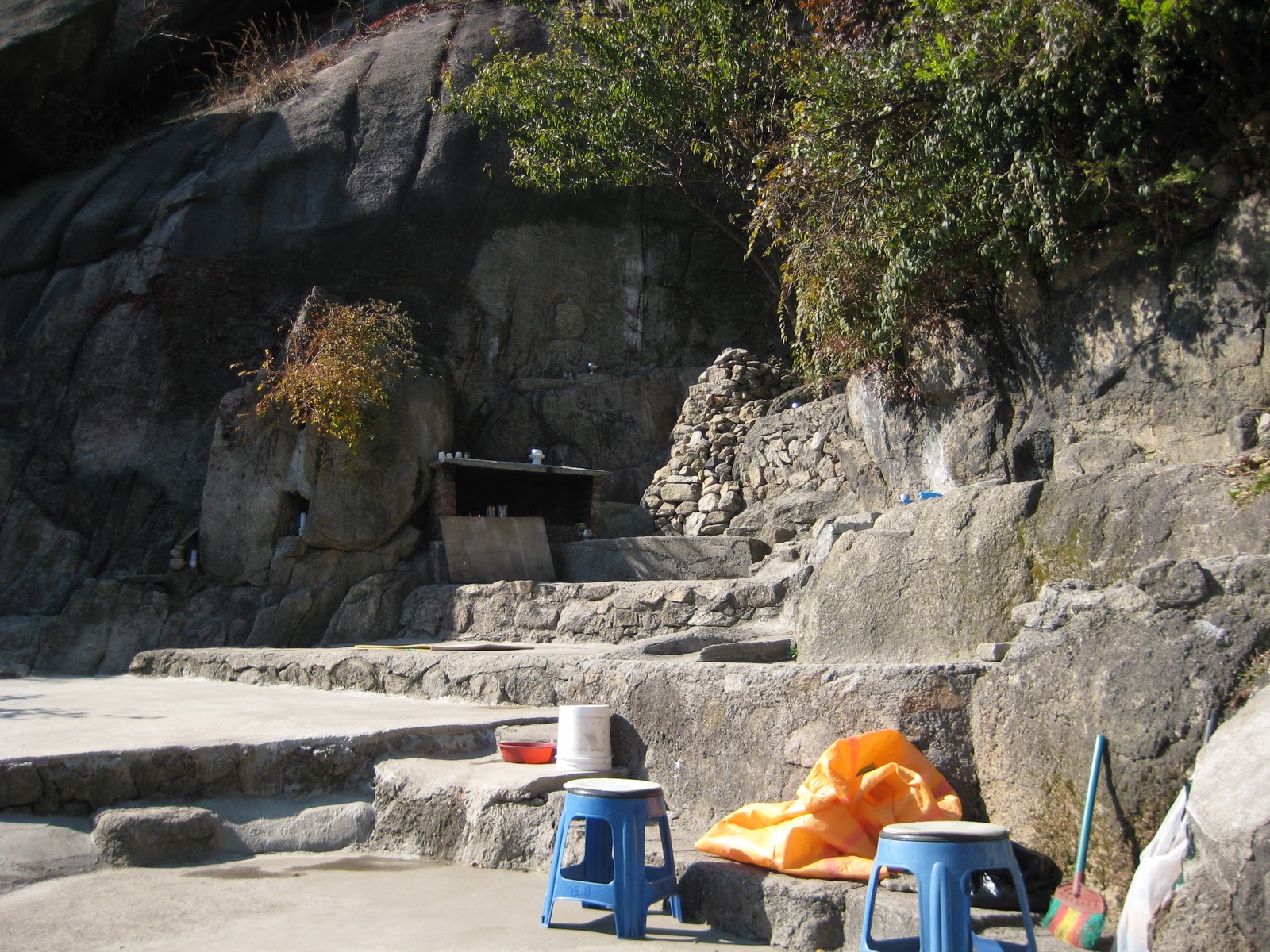
 Our path then wound its way up Inwangsan, past some Shamanist alters and shrines. Shamanists believe that the dead still need food and drink, so they leave offerings of rice, cakes, fruit, and meat (sometimes a pig's head!) along with candles and incense sticks. Tuesday mornings must not be a popular time for Shamanists, however, because we saw only two (praying) people and no ceremonies underway. Nevertheless, there was no denying the sacredness of the area. We found ourselves whispering and walking with care so as to not disturb the atmosphere.
 A natural spring along the way gave me an opportunity to fill up on water while we continued hiking up Inwangsan. The view from the top, then, was absolutely incredibly. Namsan Park, Gyeongbokgung, and Changdeokgung were all easily visible. With the restored fortress wall behind us, the city before us, and a sacred forest surrounding us, we felt a peace and beauty that defied our presence in one of the world's largest cities.


 Across the street from Dongnimmun Station (where we exited Line 3 for the Inwangsan Hill), is Seodaemun Prison, where 40,000 freedom fighters were held and tortured during the Japanese colonial rule from 1910-1945. At least 400 Koreans were killed, many of them students, and the prison was a sobering place to visit. As far as the museum and restoration goes, however, I was impressed. You are able to walk inside solitary confinement cells as well as the execution room. Many signs have only minimal English labeling, but, with the large number of pictures, no more real explanation is really needed. If you ever visit, be sure to stop at the information building on your way in - they had a great English brochure that gave us plenty of information about the prison and its history.


